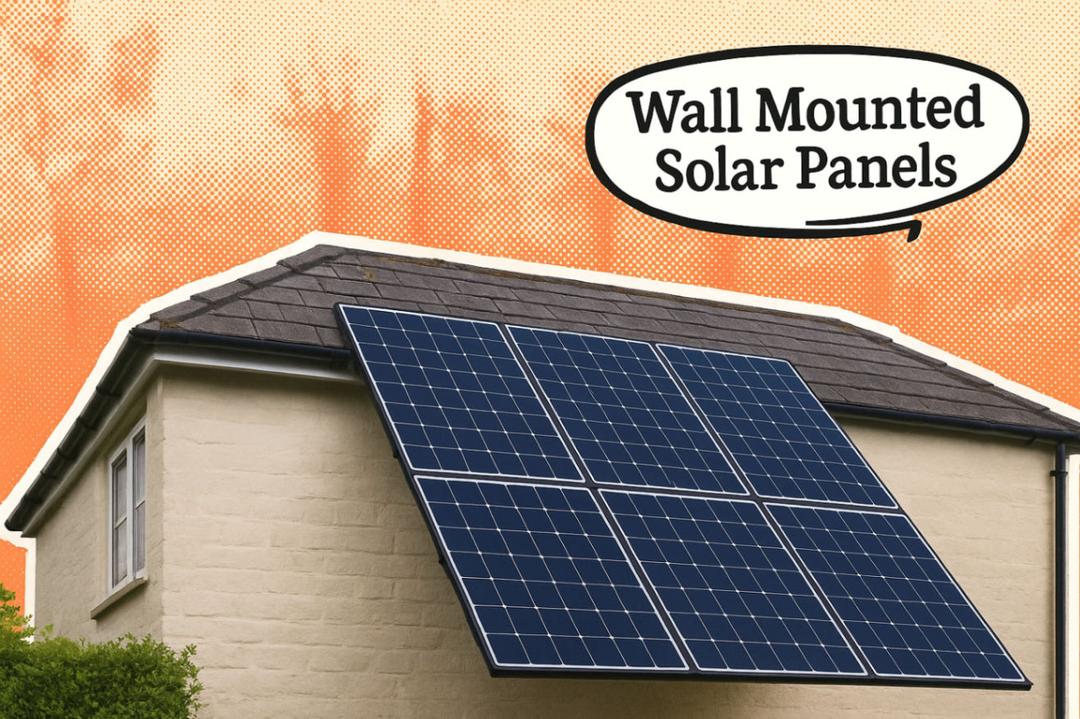

More UK homes than ever have solar panels on their roofs, but what if that’s not an option? Introducing wall-mounted solar panels.
- What Are Wall-Mounted Solar Panels?
- How Well Do Wall-Mounted Solar Panels Perform?
- How Much Do Wall-Mounted Solar Panels Cost?
- Installing Wall-Mounted Solar Panels
- Do I Need Planning Permission for Wall-Mounted Solar Panels?
- Pros & Cons of Wall-Mounted Solar Panels
- Wall-Mounted vs. Roof-Mounted Solar Panels
- Who Might Wall-Mounted Solar Panels Be Suited For?
- Who Might Wall-Mounted Solar Panels NOT Be Suited For?
It’s great that so many UK households are making the switch to solar. For some, though, there either isn’t enough space on their roof, or they don’t have access to a roof in the first place.
One option to consider is installing wall-mounted solar panels. To help you work out if they’re the right choice for you, we’ve investigated how well wall-mounted solar panels perform, what they cost, how you can install them, whether you need planning permission, and what the pros and cons are.
PS We offer MCS-certified solar panel installation nationwide. Simply answer these questions, get your fixed price and arrange your free design.
Key Points:
Wall-mounted solar panels are best on south-facing walls.
You won’t get the same performance from wall-mounted solar panels as you would from roof-mounted panels.
It’s usually more expensive to install wall-mounted solar panels because of the added complexity.
Wall-mounted solar panels are a great option if roof space is limited.
You can tilt wall-mounted solar panels to make them more effective, but not by much.
What Are Wall-Mounted Solar Panels?
Wall-mounted solar panels are exactly what they sound like - solar panels you put on the walls of your home to generate electricity.
Rather than installing solar panels on the roof, some homeowners choose to install them on their outside walls.
This is done by attaching them parallel to the wall, or hanging as a canopy. Some choose to tilt their wall-mounted solar panels at an angle, which is generally the most effective way to generate electricity.
How Well Do Wall-Mounted Solar Panels Perform?
Wall-mounted solar panels typically perform worse than roof-mounted ones, because they’re usually unable to absorb as much sunlight throughout the day.
The best angle for solar panels is between 20° and 50° (preferably facing south too) and this is much harder to achieve with wall-mounted solar panels.
You can tilt wall-mounted solar panels at a slight angle, but not to the same degree as panels on a roof.
It’s also more challenging to install as many solar panels on a wall, as there’s usually more space on a building’s roof.
A typical three-bedroom household in the UK has room for 8–10 solar panels, whereas the walls of a home this size can only support two to three panels (at best).
A 4 kilowatt peak (kWp) solar panel system (10 panels, 400W each) in the UK generates around 3,400 kilowatt hours (kWh) per year on average.
Assuming you fit three 400W solar panels on your wall, you’ll only generate around 1,020 kWh per year. This is far off the 2,700 kWh of electricity consumed on average by UK households annually.
The point is, if you can install solar panels on your roof, you probably should because it’ll be the most effective way to generate the maximum amount of electricity.
Where wall-mounted solar panels might perform better is if your only option is a south-facing wall or a north-facing roof.
In this instance, wall-mounted solar panels could actually end up generating more electricity, and most times, we tend to advise against solar panels if a north-facing roof is the only option.
Read more:
Is Your Roof Suitable For Solar Panels?
How Much Do Wall-Mounted Solar Panels Cost?
The average price of a 4 kWp residential solar PV system in the UK is £7,504, but wall-mounted solar panels cost a little more than roof-mounted panels, because they’re more difficult to install.
Specialised wall anchors are needed to make sure the solar panels, which can weigh between 18 and 22 kg each, are firmly attached vertically.
It also generally takes longer to install wall-mounted solar panels because of the added difficulty.
If you’d like to learn more about what it might cost you to install solar panels, you can get a fixed price in 60 seconds with our quote tool. It’s an obligation-free quote - no pushy calls, just a free design and an instant price.
Installing Wall-Mounted Solar Panels
The full start-to-finish process for installing wall-mounted solar panels takes two to three days, though this can vary depending on the size of your home. The number of panels installed and the overall complexity can also increase the time it takes.
Scaffolding is needed to install wall-mounted solar panels, as they’ll be mounted on brackets as close to the top of your home’s walls as possible. This is to maximise their chance of absorbing the most sunlight.
Do I Need Planning Permission for Wall-Mounted Solar Panels?
You’ll generally be fine to install wall-mounted solar panels without needing planning permission.
This is because solar panels are permitted development, and most UK homes can install them without issue.
However, if you live in a listed building or a building in a conservation area, you’ll want to double-check.
This is because listed buildings and buildings in conservation areas typically have limits on the sorts of changes you can make to the outside of the property.
Pros & Cons of Wall-Mounted Solar Panels
Despite roof-mounted solar panels usually being the best option, wall-mounted solar panels do have their advantages. Here’s a list of their pros and cons:
Pros
Wall-mounted solar panels are great for properties with limited or unusable roof space. Sometimes, a property’s roof is either too complex, or only has usable space facing north. In this instance, wall-mounted solar panels are ideal because they allow more homes and businesses access to solar power where otherwise they might not.
Maintenance for wall-mounted solar panels is easier than for roof-mounted panels. The vertical orientation of the panels means dust, dirt, and snow have a much harder time building up. And when they do, rain has an easier job removing it.
There’s less wind load on wall-mounted solar panels. With roof-mounted solar panels, wind can put strain on the roof structure, but there’s far less wind load when you mount solar panels on a wall instead.
Any excess electricity generated by your wall-mounted solar panels can be exported and sold to the grid via the Smart Export Guaranteed (SEG).
Cons
You’ll generate less electricity with wall-mounted solar panels. Roof-mounted solar panels will almost always generate more electricity, because they’re able to be angled optimally to absorb the maximum amount of sunlight. You can tilt wall-mounted solar panels to a degree, but not to the same levels as roof-mounted systems.
Wall-mounted panels are more likely to be exposed to shade, either from trees or neighbouring properties.
It’s much harder to fit as many solar panels on a wall as you would on a roof. This is the main drawback, because it makes generating comparable power from a wall-mounted system more difficult.
The added complexity installing solar panels vertically on a wall can make installing wall-mounted systems more expensive. Your overall costs might be lower, but this is only because you won’t be able to install as many panels.
Wall-Mounted vs. Roof-Mounted Solar Panels
Wall-mounted solar panels will almost always be less efficient than roof-mounted solar panels. The only time of the year wall-mounted might (emphasis on might) be more efficient than a roof-mounted system is during the winter, when the angle of the sun is lower.
Properties with limited or unsuitable roof space, or perhaps homes with north-facing roofs can be better off opting for wall-mounted solar panels.
They’re also a great option if you live in a high-rise building or one without access to a roof (although if you don’t own the building, you’d need to investigate whether you could install wall-mounted solar panels).
Read more:
Who Might Wall-Mounted Solar Panels Be Suited For?
If you live in a home with a south-facing wall with plenty of space, wall-mounted solar panels could be well suited to you - especially if you don’t have a lot of space on your roof, your roof is primarily facing north, or your roof is excessively shaded.
You might also have a roof that’s not structurally strong enough to support solar panels - an entire solar system can weigh hundreds of kilograms after all.
Additionally, some roofs have unusual shapes that can make installing solar panels difficult, if not impossible. In this instance, wall-mounted solar panels might be the best option available.
Who Might Wall-Mounted Solar Panels NOT Be Suited For?
Homes with lots of suitable roof space - and ideally one that doesn’t exclusively face north - should just get a roof-mounted solar system.
You’ll have a much easier time installing a large enough system to meet your needs, and you’ll almost certainly be able to generate more electricity throughout the year - and more consistently too.
The advancements in solar power technology are always increasing, so there may come a time soon when wall-mounted systems can provide all the electricity a home needs. For now, if you can install a roof-mounted solar system, you probably should.
Read more:
Solar Power Output UK: How Much Energy Do Panels Produce?
Conclusion
If you can’t install solar panels on your roof, a wall-mounted solar system is the next best thing. Just keep in mind that you typically won’t be generating as much electricity as roof-mounted panels, and some people won’t find wall-mounted systems as pleasing to look at.
However you look at it, getting wall-mounted solar panels still means shrinking your energy bills, reducing your carbon emissions, and lowering your reliance on the grid. Adopting any type of solar panel is going to help the environment too. A win for your wallet AND the planet!
d over to our advice section, check out our YouTube channel for informative videos, or read a customer case study to see how others have benefited from their solar installation.
Next Steps For Your Solar Journey:
When planning to install solar panels, there are several important factors to consider. Make sure to refer to the following guides to help you make informed decisions:
To dive deeper into these topics, head over to our advice section, check out our YouTube channel for informative videos, or read a customer case study to see how others have benefited from their solar installation.
Get Set for Solar with Heatable
Without boasting you should get your solar installed with us, here's why:
Thousands of Happy Customers: We boast an average score of 4.9 on Trustpilot, outperforming the market leader.
Which? Trusted Trader: Heatable is proudly recognised as a Which? Trusted Trader.
MCS Accredited: Our accreditation by the Microgeneration Certification Scheme (MCS) ensures high-quality standards.
Exclusive Panels: We offer REA Fusion solar panels, available only through Heatable.
Consumer Protection: As members of the HIES consumer code, we provide 2-year deposit protection.
Flexible Payment Options: Choose from multiple payment methods, including finance options.
Fixed Price Guarantee: Enjoy transparency with no hidden costs.
Save Your Quote: You can save your quote and decide later.
Bespoke Design Tool: Draw your own conclusion (literally) on whether solar is worth it for you, here.